


Forex Broker Commission Comparison: Trading Fees Explained
Choosing a forex broker based only on the advertised spread or a “$0 commission” claim can be misleading. The actual cost of trading depends on how the broker structures its pricing, how much you trade and which account type you use.
Some brokers charge a separate commission on each trade while offering raw or near zero spreads. Others advertise commission free trading but build their costs into a wider spread. There can also be additional expenses such as overnight financing, currency conversion fees and withdrawal charges.
That is why comparing total trading costs is more useful than comparing commission rates alone.
In this guide, we explain how forex broker commissions work, how to compare commission based and spread based pricing and how to calculate the approximate cost of a trade. We also compare the pricing structures of several major forex brokers using information published by the brokers themselves.
The goal is simple: understand what you are actually paying to open and close a forex position not just what the broker advertises.
What Is a Forex Broker Commission?
A forex broker commission is a trading fee charged separately from the spread. It is usually calculated according to your position size and may be quoted per lot, per side, or as a round-turn amount.
For example, a broker might charge $3 per side per standard lot. If you open a one-lot position and later close it, the commission would generally be:
Opening the trade: $3
Closing the trade: $3
Total round-trip commission: $6
The exact amount can vary depending on the broker, account type, instrument, position size, and account currency, so traders should always check the broker's current pricing conditions before calculating their expected costs.
Commission-based accounts are commonly paired with raw or very tight spreads. Instead of receiving a wider spread with the trading cost built into it, the trader pays a separate commission while accessing the broker's underlying spread.
For example, HFM's Zero account states that forex spreads can start from 0 and lists commission starting from $3 per 1 lot. FP Markets similarly describes its Raw account as offering raw spreads with a separate commission, while its Standard account incorporates the trading cost into the spread.
How Forex Broker Commissions Are Usually Quoted
There are several terms you need to understand when comparing broker commissions.
Per side:The commission charged for one side of the transaction. If a broker charges $3 per side, you would generally pay $3 when opening and another $3 when closing the position.
Round turn / round trip:The total commission for opening and closing a position. A $3-per-side commission would therefore equal $6 round turn, assuming the same commission applies to both legs.
Per lot:The commission is linked to the size of your position. A standard forex lot is commonly 100,000 units of the base currency, although brokers may also support mini, micro, or fractional lot sizes.
Account currency:The final commission may depend on the currency in which your trading account is denominated. Brokers can publish equivalent commission rates for different account currencies.
When comparing brokers, make sure you are comparing the same position size, instrument, account type, and commission basis. A commission quoted as "$3 per side" cannot be directly compared with another broker advertising "$6 round trip" unless you first put both figures on the same basis. How Forex Broker Commissions Work
Forex broker commissions are usually linked to the size of your position. The larger the trade, the greater the commission you may pay.
However, the number displayed on a broker's pricing page does not always represent your complete trading cost. To compare brokers accurately, you need to consider both the commission and the spread.
Commission Per Lot
Many forex brokers quote commissions based on a standard lot.
A standard forex lot represents 100,000 units of the base currency. Brokers may also offer smaller position sizes, such as mini lots, micro lots, or fractional lots.
If a broker charges $3 per side per standard lot, the commission for different position sizes would approximately scale as follows:
Position Size | Commission Per Side | Round-Trip Commission |
1.00 lot | $3.00 | $6.00 |
0.50 lot | $1.50 | $3.00 |
0.10 lot | $0.30 | $0.60 |
0.01 lot | $0.03 | $0.06 |
This illustrates why position size matters when comparing trading fees. A commission that appears inexpensive for a small trade can become significant for a high-volume trader executing many lots.
The actual commission charged can depend on the broker's account structure, instrument, account currency, and applicable trading conditions, so the broker's current fee schedule should always be checked before trading.
Per-Side vs Round-Trip Commission
One of the easiest mistakes when comparing brokers is confusing per-side and round-trip commission.
Suppose Broker A advertises:
$3 commission per side per standard lot
A trader opening and closing one standard-lot position would generally pay:
$3 + $3 = $6 round trip
By contrast, if another broker advertises a $6 round-trip commission, those two offers are broadly equivalent from a commission perspective, assuming the same instrument, position size, account currency, and applicable conditions.
Always convert commission figures to the same basis before comparing them.
Commission Depends on Trade Size
Your commission normally increases as your position size increases.
For example, if a broker charges $6 round turn per standard lot:
0.10 lot → approximately $0.60
0.50 lot → approximately $3.00
1.00 lot → approximately $6.00
2.00 lots → approximately $12.00
This is particularly important for scalpers, day traders, algorithmic traders, and other high-volume traders, because they may accumulate substantial commission costs through repeated transactions.
A trader who makes only a few trades each week may be affected more by spread and overnight financing than by the nominal commission rate.
Commission Is Only One Part of the Trading Cost
A broker's commission should not be evaluated in isolation.
The basic transaction-cost calculation can be thought of as:
Total trading cost ≈ spread cost + commission
For a position held beyond the broker's applicable daily financing period, swap or overnight financing can create an additional cost or, depending on the instrument and position, potentially a credit.
Other charges may also apply, including currency-conversion fees, deposit or withdrawal charges, or account-related fees, depending on the broker and payment method.
This is why a broker advertising "$0 commission" is not automatically cheaper than a broker charging a separate commission.
A commission-free account may simply incorporate more of the broker's trading cost into its spread.
A Simple Cost Example
Consider two hypothetical pricing models for a one-standard-lot EUR/USD trade.
Broker A
Spread: 0.2 pip
Commission: $3 per side
Round-trip commission: $6
Using a simplified assumption of approximately $10 per pip for one standard lot of EUR/USD:
Spread cost:0.2 × $10 = $2
Commission:$3 + $3 = $6
Approximate round-trip transaction cost:$2 + $6 = $8
Broker B
Spread: 0.8 pip
Commission: $0
Using the same simplified assumption:
Spread cost:0.8 × $10 = $8
Approximate round-trip transaction cost:$8
In this example, both pricing models produce approximately the same transaction cost even though one broker charges a separate commission and the other does not.
This demonstrates the key point of broker-cost comparison:
The lowest advertised commission is not necessarily the lowest overall trading cost.
The example above is illustrative rather than a quote for any specific broker. Actual spreads, pip values, commissions, and execution conditions vary by currency pair, account type, market conditions, and broker.
Spread vs Commission: What's the Difference?
The spread and commission are two of the most common ways forex brokers charge for executing trades.
Although they are different types of charges, they both affect the cost of entering and exiting a position. Comparing only one of them can therefore give you an incomplete picture of a broker's pricing.
What Is the Forex Spread?
The spread is the difference between the bid price and the ask price of a currency pair.
For example, if EUR/USD is quoted at:
Bid: 1.08500
Ask: 1.08520
The difference is 0.00020, or 2.0 pips.
The spread represents an immediate trading cost because a trader generally enters a position at one side of the quote and would need the market price to move enough to overcome the spread before the position becomes profitable, all else being equal.
Some brokers advertise spreads “from 0.0 pips.” This means the spread can reach that level under certain conditions; it does not mean that the pair will continuously trade with a zero spread.
Spreads can change according to market liquidity, volatility, trading session, instrument, and account type.
What Is a Forex Commission?
A commission is a separate charge applied to a trade according to the broker's pricing structure.
For example, a raw-spread account might offer very tight spreads while charging a fixed commission per lot.
If the commission is $3 per side for one standard lot:
Opening: $3Closing: $3Total: $6 round trip
The trader therefore needs to consider the commission together with the spread when calculating the actual transaction cost.
Spread-Only vs Commission-Based Pricing
Forex accounts generally fall into two broad pricing structures.
Pricing Model | Spread | Separate Commission | Common Structure |
Spread-only | Usually wider | No | Trading cost incorporated into spread |
Raw spread + commission | Usually tighter | Yes | Lower spread plus commission |
Hybrid/account-specific | Varies | Varies | Depends on broker and account |
Neither model is automatically cheaper.
A trader should compare the combined cost of the spread and commission for the same trade size and instrument.
Why a 0.0-Pip Spread Isn't Necessarily Free
A 0.0-pip spread can sound attractive, but it does not tell you the complete cost of the trade.
Suppose a broker offers a raw-spread account with spreads starting from 0.0 pips but charges a commission per lot.
The trader may benefit from a very tight market spread while paying a separate execution commission.
Another broker might offer a wider spread but no separate commission.
The second broker could potentially have the same or even a lower overall cost depending on the actual spreads and commission rates.
That's why experienced traders often look at the all-in trading cost rather than focusing on a single headline number.
Commission-Free Does Not Mean Cost-Free
The same principle applies in reverse.
A broker advertising “$0 commission” may still charge for trades through its spread.
For example, if one account has:
0.2-pip spread
$6 round-trip commission
and another has:
0.8-pip spread
$0 commission
the commission-free account is not automatically cheaper.
Using the simplified EUR/USD example from the previous section, both could produce approximately the same $8 round-trip transaction cost for a one-standard-lot trade.
The important number is therefore not:
“How much is the commission?”
It is:
“How much will this trade cost me from entry to exit?”
What Is an All-In Trading Cost?
An all-in cost combines the major transaction charges associated with opening and closing a trade.
For a simplified comparison:
All-in transaction cost ≈ spread cost + round-trip commission
For example:
Spread: 0.3 pip
Approximate value: $3 for one standard lot of EUR/USD
Round-trip commission: $6
Approximate transaction cost:
$3 + $6 = $9
This provides a much more meaningful comparison than saying one broker has a 0.3-pip spread while another has a 0.8-pip spread.
However, this calculation does not include every possible trading expense. Overnight financing, currency conversion, withdrawal fees, and other charges should be evaluated separately where applicable.
Which Pricing Model Is Better?
It depends on how you trade.
Scalpers and high-frequency traders often pay close attention to raw spreads and commissions because they may execute a large number of trades. Even small differences in transaction costs can accumulate quickly.
Day traders may also benefit from comparing all-in costs, particularly if they frequently trade major currency pairs.
Swing traders may place fewer trades, making the spread and commission less important relative to other costs such as overnight financing.
Beginners may prefer a simpler pricing structure, but simplicity should not be confused with lower cost. A commission-free account can be easier to understand while still having a wider spread.
There is therefore no single pricing model that is best for every trader.
The right comparison depends on trade frequency, position size, instruments traded, holding period, and account conditions.
Standard vs Raw Spread Forex Accounts
Forex brokers generally offer two main pricing models: standard spread accounts and raw spread accounts. Understanding the difference is important when comparing broker commissions because a lower commission does not necessarily mean a lower overall trading cost.
Standard Spread Accounts
With a standard spread account, the broker typically builds its trading charge into the spread. Instead of paying a separate commission on each trade, traders receive a quoted bid-ask spread that is generally wider than the underlying market spread.
For example, if EUR/USD is quoted at 1.10000 on the bid and 1.10020 on the ask, the spread is 2.0 pips. If there is no separate commission, that spread represents the primary trading cost.
Standard accounts can be simpler for beginners because the cost is visible directly in the quoted spread. They can also be suitable for traders who place fewer trades and are less concerned with obtaining the lowest possible spread.
Raw Spread Accounts
Raw spread accounts, sometimes called ECN, RAW, or commission-based accounts, generally provide spreads closer to the underlying market price. In exchange, the broker charges a separate commission, usually based on the trading volume.
For example, a broker might offer EUR/USD with a raw spread that can approach 0 pips while charging a commission of several dollars per standard lot. The actual cost of the trade therefore comes from both the spread and the commission.
This pricing structure can be particularly relevant for scalpers, day traders, and other high-volume traders because even small differences in transaction costs can have a meaningful impact over hundreds of trades.
Which Account Type Is Cheaper?
There is no universal answer. The cheaper option depends on the broker's spread, commission, trading volume, account type, and the instrument being traded.
The best way to compare accounts is to calculate the total trading cost rather than looking at the commission or spread alone:
Total Trading Cost = Spread Cost + Commission
For this reason, a broker advertising a $3 commission per lot may not necessarily be cheaper than a broker charging $3.50 if the first broker consistently offers wider spreads.
When comparing forex brokers, traders should therefore look at the complete pricing structure and consider the cost for their typical trade size and trading strategy.
Forex Broker Commission Comparison
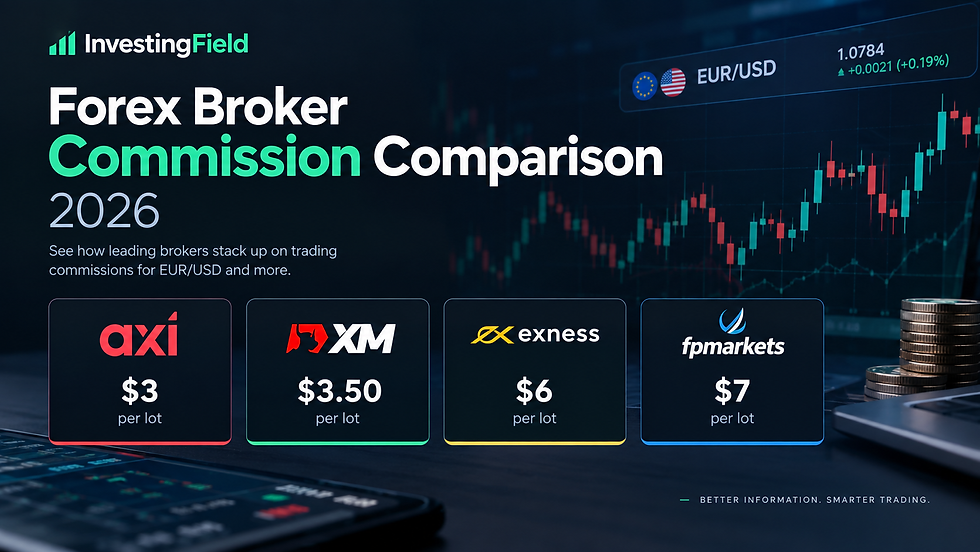
The table below compares the commission structures of five widely used forex brokers with raw or commission-based account options. Commission figures are shown for a standard lot of 100,000 units and should be considered alongside the applicable spread.
Broker | Account | Raw Spread From | Commission Per Side | Round-Trip Commission |
FP Markets | Raw | 0.0 pips | $3.00 | $6.00 |
Vantage | RAW ECN | 0.0 pips | $3.00 | $6.00 |
Pepperstone | Razor | 0.0 pips | $3.50 | $7.00 |
Exness | Raw Spread | 0.0 pips | Up to $3.50 | Up to $7.00 |
Axi | Pro | Lower spreads | $3.50 | $7.00 |
Commission and spread conditions can vary by account, trading platform, instrument, account currency, jurisdiction, and market conditions. Traders should verify the current pricing applicable to their specific account before opening a position.
FP Markets
FP Markets' Raw account advertises forex spreads starting from 0.0 pips with a commission of $3 per standard lot per side, equivalent to $6 for a complete opening-and-closing transaction. Its Standard account instead incorporates the trading cost into the spread without a separate forex commission.
Vantage
Vantage's RAW ECN account advertises spreads from 0.0 pips and a forex commission of $3 per standard lot per side, or $6 round trip. Vantage also offers a Pro ECN structure with a lower commission for qualifying accounts, so traders should check the account requirements rather than comparing the headline RAW ECN rate alone.
Pepperstone
Pepperstone's Razor account uses raw-spread pricing with a commission starting at $3.50 per standard FX lot per side in a USD-denominated account. That equals $7 for a complete round trip. Pepperstone currently lists EUR/USD Razor spreads starting from 0.0 points, with an average spread of 0.1 points for the period shown on its pricing page.
Exness
Exness' Raw Spread account advertises spreads from 0 pips with commission of up to $3.50 per side per lot. The exact commission can vary by instrument, so the maximum headline figure should not automatically be treated as the cost for every forex pair.
Axi
Axi's Pro account uses lower spreads together with a $3.50 commission per standard lot, or $7 round trip. Its Standard account does not charge a separate forex commission and instead incorporates the trading cost into the spread.
Which Broker Has the Lowest Commission?
Based purely on the standard commission figures shown above, FP Markets and Vantage have the lowest headline commission among these five at $3 per lot per side. However, that does not automatically make them the lowest-cost brokers overall.
A proper comparison needs to consider the spread as well as the commission. For example, a broker charging $3.50 per side could potentially have a lower total transaction cost than a broker charging $3 if its average spread is sufficiently tighter.
This is why traders should compare the all-in cost of a trade, rather than choosing a broker solely by its advertised commission.
For active traders, the difference can become significant. A $1 difference in round-trip commission across 100 standard-lot trades represents $100 before considering differences in spreads, swaps, or other charges.
How Much Does It Cost to Trade 1 Lot?
The easiest way to understand forex broker costs is to convert the spread and commission into an actual dollar amount.
For a standard lot of 100,000 units on EUR/USD, one pip is worth approximately $10 when the trading account is denominated in U.S. dollars. This makes EUR/USD a useful example for comparing different pricing models.
Example 1: Standard Account
Suppose a standard account has a 1.2-pip spread and does not charge a separate forex commission.
For one standard lot:
1.2 pips × $10 = $12
The approximate spread cost is therefore $12 for the trade's round trip, assuming the quoted spread remains unchanged and ignoring other costs such as swaps and slippage.
Example 2: Raw Spread Account
Now consider a raw spread account with:
Raw spread: 0.2 pips
Commission: $3.50 per side
Position: 1 standard lot
The spread component is:
0.2 × $10 = $2
The commission for opening and closing the position is:
$3.50 × 2 = $7
The combined trading cost is therefore:
$2 + $7 = $9
So, despite the raw account charging a separate commission, its hypothetical $9 transaction cost would be lower than the $12 cost of the standard account in this example. The same calculation is commonly used to convert spread and commission into an all-in trading cost.
What Happens With Smaller Trade Sizes?
Trading costs generally scale with position size.
Position | Approx. EUR/USD pip value | Example $7 round-trip commission |
1.00 lot | $10/pip | $7.00 |
0.10 lot | $1/pip | $0.70 |
0.01 lot | $0.10/pip | $0.07 |
For example, if a broker charges $3.50 per lot per side, trading 0.10 lots would result in approximately $0.70 in round-trip commission, before considering the spread.
The Formula Traders Can Use
The basic calculation is:
Spread Cost = Spread × Pip Value × Position Size
For a commission-based account:
Commission = Commission Per Lot Per Side × Position Size × 2
Then:
Total Trading Cost = Spread Cost + Commission
This calculation gives traders a more useful comparison than looking at the advertised spread or commission separately.
Why Position Size Matters
A difference of just a few dollars per standard lot may appear insignificant on a single trade. However, the impact becomes much larger for active traders.
For example, if the difference between two brokers is $2 per round-trip lot and a trader completes 500 standard-lot round trips, the difference would amount to approximately $1,000 before considering other trading costs.
This is why commission comparisons are particularly important for scalpers, day traders, and high-volume strategies.
However, the calculation above is still a simplified comparison. Actual trading costs can also be affected by variable spreads, swaps, slippage, currency conversion, and other account-specific charges. For a realistic broker comparison, these factors should be considered alongside the advertised commission.
Which Forex Account Type Is Better?
The better account type depends on how you trade, how frequently you trade, and whether you prefer a simpler pricing structure or potentially tighter spreads with a separate commission.
Raw Spread Accounts for Scalpers
Raw spread accounts can be attractive to scalpers because they generally provide tighter spreads while charging a separate commission.
For a strategy that enters and exits the market frequently, even a small reduction in the spread can matter. However, traders should compare the combined spread and commission, rather than assuming that a raw spread account will always be cheaper.
Scalpers should also pay attention to execution quality, slippage, minimum commissions, and the broker's average—not just minimum—spreads.
Raw Spread Accounts for Day Traders
Day traders may also benefit from commission-based pricing when they regularly trade standard or larger position sizes.
For example, a trader completing several round trips during a trading session can accumulate significant transaction costs. A small difference in the all-in cost per lot can therefore have a meaningful effect on overall trading expenses.
However, the cheapest commission structure is not necessarily the best choice. Execution speed, liquidity, available instruments, and trading conditions can be equally important.
Standard Accounts for Beginners
Standard spread accounts can be easier for beginners to understand because the broker's primary trading charge is incorporated into the spread rather than being presented as a separate commission.
This means traders can often estimate their basic transaction cost simply by looking at the spread.
For someone who trades relatively infrequently or uses smaller position sizes, the simplicity of a standard account may be more valuable than achieving the lowest possible raw spread.
What About Swing Traders?
Swing traders should look beyond commission when comparing brokers.
Because positions can remain open for days, overnight financing or swap costs can become more important than a small difference in the entry spread or commission.
A broker with slightly higher transaction costs but more competitive overnight financing could potentially be more suitable for a trader who holds positions for several days.
A Simple Way to Choose
As a general starting point:
Trader type | Account structure to consider | Main factor to compare |
Beginner | Standard | Simplicity and overall spread |
Scalper | Raw/commission | All-in cost and execution |
Day trader | Raw/commission | Cost per round trip |
High-volume trader | Raw/commission | Commission + average spread |
Swing trader | Either | Spread + swaps |
Occasional trader | Standard | Simplicity and total cost |
These are general guidelines rather than universal rules. The most suitable account depends on the trader's position size, frequency, instruments, and holding period.
Don't Compare Commission Alone
A broker charging $3 per side is not automatically cheaper than one charging $3.50.
Suppose Broker A charges $3 per side with a 0.5-pip effective spread, while Broker B charges $3.50 per side with a 0.1-pip spread. On EUR/USD, the additional $1 in round-trip commission at Broker B could be offset by the tighter spread.
The correct comparison is therefore:
Commission + spread + other applicable trading costs
This is the figure traders should use when evaluating competing forex brokers.
How to Calculate Your Total Forex Trading Cost
Comparing forex brokers by commission alone can give you an incomplete picture of what you will actually pay to trade. A more accurate comparison considers the spread, commission, overnight financing, slippage, and any other applicable charges.
For a basic forex trade, the core calculation is:
Total Trading Cost = Spread Cost + Commission
For positions held overnight, financing costs may need to be added as well.
1. Calculate the Spread Cost
The spread is the difference between the bid and ask price.
For EUR/USD, where one standard lot is 100,000 units, a pip is approximately worth $10 when the account is denominated in USD.
For example, if the effective spread is 0.8 pips:
0.8 × $10 = $8
The spread component of the transaction therefore costs approximately $8 for one standard lot.
The pip value will differ depending on the currency pair, exchange rate, account currency, and position size, so the $10 figure should not be applied universally to every forex pair.
2. Add the Broker Commission
If the account charges a separate commission, include both the opening and closing commission.
For example:
Commission: $3.00 per side
Position: 1 standard lot
Opening commission: $3.00
Closing commission: $3.00
Round-trip commission = $6.00
If the same account has a 0.8-pip spread on EUR/USD:
Spread = $8
Commission = $6
Estimated trading cost = $14
This is a much more meaningful figure for comparing the account against another broker.
3. Consider Overnight Financing
If a position remains open after the broker's daily rollover time, a swap or overnight financing charge may apply.
The amount depends on the currency pair, direction of the trade, broker, interest-rate environment, and number of nights the position remains open.
For this reason, a broker with an attractive spread and commission may not necessarily be the most cost-effective choice for a trader who regularly holds positions overnight.
Swing traders should therefore compare financing rates alongside the initial transaction cost.
4. Account for Slippage
The price at which an order is actually executed may differ from the price displayed when the order is submitted. This difference is known as slippage.
Slippage can increase the effective cost of entering or exiting a position, particularly during periods of high volatility, economic announcements, or reduced market liquidity.
It is therefore useful to distinguish between a broker's advertised minimum spread and the trading conditions a trader actually experiences.
5. Check Currency Conversion and Other Charges
Depending on the broker and account structure, additional costs can include currency conversion charges, withdrawal fees, inactivity fees, or other account-specific charges.
These costs may have little impact on an active trader who deposits and trades in the same base currency, but they can become relevant when comparing brokers with different account currencies or funding methods.
A Practical All-In Cost Formula
For a more complete comparison, traders can use:
All-In Trading Cost = Spread Cost + Round-Trip Commission + Financing + Other Applicable Costs
Slippage is best evaluated separately because it varies with execution conditions rather than being a fixed broker charge.
For example, consider a hypothetical EUR/USD trade of one standard lot:
Cost component | Example |
Spread | 0.8 pips |
Spread cost | $8 |
Commission | $3 per side |
Round-trip commission | $6 |
Overnight financing | $0 |
Other fees | $0 |
Estimated trading cost | $14 |
This calculation provides a much better basis for comparing forex brokers than looking at the advertised commission by itself.
Why All-In Cost Matters
A difference of a few dollars on one trade may appear small. For an active trader, however, those differences can accumulate quickly.
If the average cost difference between two brokers is $2 per round-trip lot and a trader completes 500 standard-lot round trips, the difference would be:
$2 × 500 = $1,000
This is why traders should compare the pricing structure against their actual trading volume and strategy.
A broker offering the lowest advertised commission may not have the lowest overall cost once spreads and other charges are included.
What Other Forex Broker Fees Should You Check?
Commission and spread are usually the first costs traders compare, but they are not the only charges that can affect the overall cost of using a forex broker.
Before opening an account, traders should review the broker's complete fee schedule and consider how each charge applies to their trading strategy.
Overnight Swap and Financing Fees
Swap, also known as overnight financing, is a charge or credit that may apply when a forex position remains open beyond the broker's daily rollover period.
The amount can vary substantially between currency pairs and between long and short positions. Traders who hold positions for several days should therefore pay particular attention to financing rates.
For short-term traders who close all positions before rollover, this cost may be less important.
Deposit and Withdrawal Fees
Some brokers may charge fees for certain deposit or withdrawal methods, while others absorb some or all transaction costs.
The availability and cost of payment methods can also depend on the trader's country and account currency.
When comparing brokers, check:
Minimum deposit requirements
Available payment methods
Withdrawal charges
Processing times
Currency conversion requirements
A broker with competitive trading costs may become less attractive if funding and withdrawal costs are high for your particular payment method.
Currency Conversion Costs
Currency conversion can become relevant when your account's base currency differs from the currency used for deposits, withdrawals, or certain transactions.
For example, a trader funding a USD-denominated account from a PKR bank account may incur conversion costs through the bank, payment provider, or broker.
These charges are separate from the forex trading commission and should be considered when calculating the total cost of maintaining and funding an account.
Inactivity Fees
Some brokers may apply an inactivity or dormant-account fee after an account has remained unused for a specified period.
This is generally more relevant to occasional traders than to active traders.
If you expect to trade only occasionally, check the broker's current terms before opening an account.
Minimum Commission Charges
A broker may advertise a commission per lot, but some account structures can have minimum commission requirements.
This matters particularly for traders using very small position sizes.
For example, a trader using 0.01 lots should not automatically assume that a $3-per-lot commission will always translate into exactly $0.03 per side. The broker's commission schedule and minimum-charge rules need to be checked first.
Guaranteed Stop or Other Optional Costs
Some brokers charge additional fees for specific order types or premium features, while others incorporate them into their pricing structure.
These costs may not affect every trader, but they should be considered if you regularly use specialized risk-management or trading features.
Which Fees Matter Most?
The importance of each fee depends on the trading strategy.
Trader profile | Costs to pay particular attention to |
Scalper | Spread, commission, execution and slippage |
Day trader | Spread, commission and execution |
Swing trader | Spread, commission and overnight financing |
High-volume trader | Commission, spread and execution |
Occasional trader | Spread, inactivity and funding fees |
Long-term position trader | Financing and conversion costs |
The key is to compare broker costs according to how you actually trade rather than choosing a broker based on a single advertised fee.
A broker with a low commission may be attractive for a high-frequency trader, while another broker with slightly higher transaction costs but competitive financing could be more suitable for a trader who holds positions for several days.
Always Check the Broker's Current Fee Schedule
Forex pricing can change, and different jurisdictions or account types can have different conditions. Minimum spreads, commissions, financing rates, and other charges should therefore be verified directly with the broker before opening an account.
The figures shown in a broker comparison should be treated as a starting point for research, not as a guarantee of the exact cost you will receive.
How to Choose a Forex Broker Based on Trading Costs
A low commission is useful, but it should not be the only factor when choosing a forex broker. The right broker depends on the relationship between spreads, commissions, execution, financing costs, and your trading activity.
Use the following checklist when comparing brokers.
1. Compare the All-In Cost
Start by calculating the expected cost of a typical trade.
For commission-based accounts, combine the spread with the round-trip commission. This gives you a more realistic starting point for comparing different pricing structures.
For example, a broker offering a 0.1-pip spread with a $7 round-trip commission may be more competitive than a broker advertising a 0-pip spread with a substantially higher commission.
The numbers should always be evaluated together.
2. Use Average Spreads, Not Just Minimum Spreads
A broker may advertise spreads “from 0.0 pips,” but this does not mean the spread will remain at 0.0 pips throughout the trading day.
Spreads can widen during periods of low liquidity, market volatility, and major economic announcements.
When possible, compare typical or average spreads for the currency pairs you actually trade.
3. Match the Account to Your Trading Volume
Your trading frequency can determine how important commission becomes.
A trader completing a handful of trades each month may place less emphasis on a small difference in commission. For a high-volume trader, however, the same difference can accumulate into a significant expense.
Consider your expected:
Number of trades
Average position size
Monthly trading volume
Typical holding period
Then calculate the estimated monthly cost under each broker's pricing structure.
4. Consider Execution and Slippage
A low advertised trading cost is less useful if actual execution consistently produces unfavorable slippage.
Execution quality can be particularly important for scalpers and traders operating around major economic announcements.
Look beyond the advertised spread and consider the broker's execution model, liquidity arrangements, order execution statistics where available, and the conditions under which spreads can widen.
5. Check Overnight Financing
If you regularly hold positions overnight, compare swap or financing rates for the currency pairs you trade.
A broker with slightly higher transaction costs may still be more appropriate if its financing costs are competitive for your strategy.
This is especially important for swing and position traders.
6. Check the Exact Account Conditions
Broker pricing can differ according to:
Account type
Trading platform
Account currency
Instrument
Client jurisdiction
Trading volume
Professional or retail status
Do not assume that a commission advertised on a broker's main pricing page automatically applies to every account.
Always check the conditions for the specific account you intend to use.
7. Consider Regulation and Client Protection
Trading costs should never be considered separately from the broker's regulatory position and client-protection arrangements.
Before depositing funds, verify which legal entity will hold your account and which financial regulator supervises that entity.
Depending on the jurisdiction, client-money rules, investor protections, leverage limits, and dispute-resolution mechanisms can differ substantially.
8. Calculate Your Expected Monthly Cost
One of the most useful ways to compare brokers is to estimate the cost based on your own trading volume.
For example, suppose your average round-trip cost is $7 per standard lot and you trade 100 standard lots during a month:
$7 × 100 = $700
If another broker's equivalent all-in cost is $6 per lot:
$6 × 100 = $600
The difference is:
$700 − $600 = $100 per month
At 1,200 standard lots per year, that same $1-per-lot difference would equal approximately $1,200 annually, before considering changes in spreads, financing, or execution.
This approach is much more useful than simply selecting the broker with the lowest advertised commission.
Forex Broker Cost Comparison Checklist
Before choosing a broker, ask:
What is the commission per lot?
Is the commission quoted per side or round trip?
What are the typical spreads for my main currency pairs?
Are minimum spreads substantially different from average spreads?
Are there minimum commission charges?
What are the overnight financing rates?
Are there deposit or withdrawal charges?
Are currency conversion fees applicable?
Is there an inactivity fee?
Which regulated entity will hold my account?
How does the broker handle execution and slippage?
Does the pricing structure suit my trading volume?
A broker that performs well across these categories may be more suitable than one that simply advertises the lowest commission.
Forex Broker Commission FAQs
What is the average forex broker commission?
Forex broker commissions vary by broker, account type, instrument, and client jurisdiction. For many raw-spread forex accounts, commissions are commonly quoted on a per-lot, per-side basis. A commission of $3 to $4 per standard lot per side is a useful example range, but traders should always check the broker's current pricing schedule.
The commission should also be considered alongside the spread because the lowest commission does not necessarily produce the lowest overall trading cost.
Is a lower forex commission always better?
No. A lower commission does not automatically mean a lower trading cost.
For example, one broker might charge $3 per side but provide a wider spread, while another charges $3.50 per side and offers consistently tighter spreads. The second broker could have the lower all-in cost.
Compare commission + spread for the currency pairs and position sizes you actually trade.
Is $3 per lot a good forex commission?
A $3-per-side commission is competitive compared with many commission-based forex accounts, but the commission alone is not enough to determine whether an account is inexpensive.
You should also check the account's average spread, execution conditions, minimum commission rules, overnight financing, and any other applicable fees.
Do forex brokers charge commission on both sides of a trade?
Usually, when a broker quotes a commission per side, the charge applies when the position is opened and again when it is closed.
For example, a $3-per-side commission on one standard lot would result in:
$3 entry + $3 exit = $6 round-trip commission
Always check whether the broker is quoting its commission per side or for the complete round trip.
Are raw spread accounts cheaper than standard accounts?
Not necessarily.
Raw spread accounts typically offer tighter spreads while charging a separate commission. Standard accounts generally incorporate the broker's trading charge into the spread.
The cheaper option depends on the actual spread, commission, position size, and trading frequency.
What is the cheapest way to trade forex?
There is no single cheapest broker or account for every trader.
The lowest-cost option depends on the currency pair, trade size, trading frequency, account type, and whether positions are held overnight.
The best approach is to compare the all-in cost for your typical trades rather than choosing a broker based on its headline commission or minimum spread.
How do I compare forex broker commissions?
Start by putting each broker's pricing into the same format.
Compare:
Commission per side
Round-trip commission
Typical spread
Spread cost for your position size
Overnight financing
Other applicable fees
You can then estimate the total cost for a typical trade and, if you trade frequently, calculate the expected monthly or annual cost.
Do forex commissions vary by currency pair?
They can.
Some brokers use different commission schedules depending on the instrument, account type, or trading volume. In addition, the pip value and spread can differ between currency pairs.
This means a commission comparison based only on EUR/USD may not accurately represent the cost of trading other pairs.
Should beginners choose a commission-free forex account?
A standard account with no separate forex commission can be easier for a beginner to understand because the primary trading cost is incorporated into the spread.
However, "commission-free" does not mean "cost-free." The broker still earns through the spread or other applicable charges.
Beginners should compare the total trading cost and understand how the account is priced before choosing an account type.
Conclusion
Comparing forex broker commissions requires more than finding the broker with the lowest advertised fee.
A proper comparison should consider the commission, spread, position size, trading frequency, execution conditions, overnight financing, and other applicable charges. Raw-spread accounts can be attractive for active traders, while standard spread accounts may offer a simpler pricing structure for beginners and occasional traders.
The most useful number is ultimately the total cost of your typical trade.
Before choosing a forex broker, calculate the expected all-in cost for the currency pairs and position sizes you actually trade, then verify the broker's current pricing and regulatory information directly.
A low commission can reduce trading expenses, but the best broker is the one whose overall pricing and trading conditions fit your strategy, not necessarily the one with the lowest headline commission.



Comments